


Disclaimer: This content is for informational purposes only and should not be considered legal, financial, or investment advice. Real estate laws, zoning regulations, and market conditions can vary across Texas markets, and BatchLeads does not provide legal or financial advice. Always conduct proper due diligence before making investment decisions.
Key Takeaways:
- Texas, being a non-disclosure state, makes off-market investing more relationship and information-driven, pushing many investors toward direct-to-owner outreach and distressed property strategies.
- Rising inventory, longer selling times, and increasing price reductions across Texas markets are creating new opportunities for investors searching for motivated sellers and off-market deals.
- Investors are increasingly using platforms like BatchLeads to search nationwide for off-market properties, stack distress indicators, skip trace owners, and uncover hidden opportunities before they hit the MLS.
Texas operates as a non-disclosure state, meaning home sale prices are not publicly disclosed. Because of this, many investors focus more on direct-to-owner outreach, distress indicators, and local property information to uncover off-market opportunities early.
As of March 2026, Texas had more than 309,000 homes for sale, nearly 30% of listings saw price drops, and median days on market climbed to 82 days — signaling a market where motivated sellers and distressed properties may be becoming easier to find.
Whether you’re wholesaling in Houston, searching for off-market properties in Austin, TX, or building rental portfolios across Dallas and San Antonio, finding off-market deals in Texas can help create a more consistent pipeline of investment opportunities.
What Is an Off-Market Distressed Property?

An off-market property is any property that has not been listed on the Multiple Listing Service (MLS). These properties are often sold privately or discovered through direct outreach rather than traditional real estate listings. In some cases, they may be “pocket listings,” where an agent is quietly marketing the property to a select group of buyers.
However, distressed off-market properties are usually off-market for different reasons, such as financial hardship, deferred maintenance, foreclosure concerns, or owners who are not yet ready to publicly sell.
When a distressed property is also off-market, it can create opportunities for investors to connect directly with motivated sellers before the property reaches the public market.
How to Find a Distressed Property That Is Off-Market in Texas
We’re going to be honest here — one of the fastest and most efficient ways to find off-market properties in Texas today is through a property information platform like BatchLeads.
Instead of manually digging through county records or spending hours driving through neighborhood after neighborhood, investors can search, filter, and organize off-market opportunities based on specific distress indicators from one platform. Whether you’re looking for pre-foreclosures, vacant homes, absentee owners, tax delinquent properties, or high-equity opportunities, platforms like BatchLeads help streamline the process significantly.
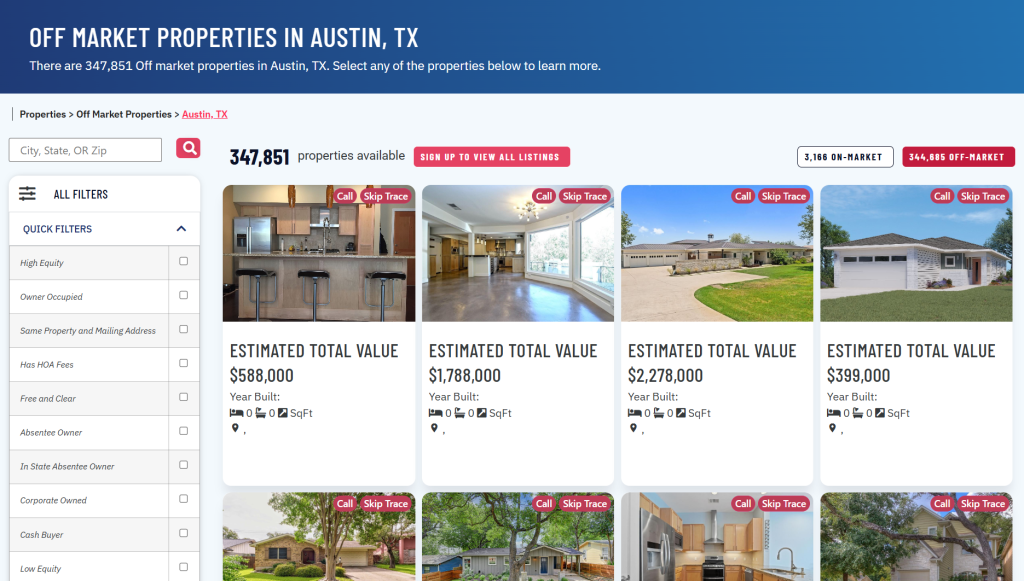
Here is BatchLeads Property Search in action for finding off-market properties in Austin, TX. With access to over 140 custom filters, investors can narrow down opportunities based on distressed factors like absentee ownership, vacancies, tax delinquency, and more — helping uncover hidden deals before they hit the MLS. Start your 7-day free trial of BatchLeads today.
It also includes one of the crowd-favorite strategies among investors: Driving for Dollars, including Virtual Driving for Dollars, allowing users to identify distressed properties without spending all day physically scouting neighborhoods.
That said, traditional methods still absolutely work.
Traditional Ways Investors Find Off-Market Properties in Texas
Public Records Research
County public records can reveal valuable distress signals tied to off-market opportunities. Investors often search for pre-foreclosure filings, tax delinquent properties, liens, probate cases, and ownership transfers to identify potentially motivated sellers.
Networking and Referrals
Attending real estate networking events, REI meetups, Facebook groups, and local investor communities can sometimes uncover off-market opportunities before they become publicly known. For newer investors, especially, these groups can also be one of the best places to start connecting, learning different investing strategies, finding potential mentors, and even connecting with cash buyers.
Related Read: 10 Proven Ways to Find Cash Home Buyers
Canvassing Neighborhoods
Some investors take a more direct approach by knocking on doors or speaking with neighbors in certain areas to gather information on vacant or distressed properties. This can also help identify seller situations not yet visible on real estate platforms.
Networking With Industry Professionals
Contractors, property managers, attorneys, probate specialists, wholesalers, and local agents often hear about distressed situations before the public does. Building such relationships earlier in your career can help in the long run.
Benefits of Buying Off-Market Properties in Texas
Buying off-market properties in Texas continues to attract investors for reasons beyond simply finding discounted deals.
Texas remains one of the fastest-growing states in the country, with major metros like Dallas-Fort Worth, Houston, Austin, and San Antonio continuing to see strong population growth, job creation, and business expansion. Many AI tech giants are moving to Texas, along with jobs in healthcare, manufacturing, and logistics, which continue to drive long-term housing and rental demand across many Texas markets.
Texas is also generally considered a landlord-friendly state, which continues attracting buy-and-hold investors looking to build rental portfolios. The state does not have statewide rent control, does not impose statutory caps on security deposits, and allows landlords greater lease structuring flexibility than many other states.
What to Watch Out for When Buying Off-Market Properties in Texas

One of the biggest challenges is visibility. As you’re already aware, Texas is a non-disclosure state, and investors often have less publicly available sale information as a result. This can make pricing, comp analysis, and estimating true market value more difficult, particularly for newer investors.
Investors should also watch out for:
- Unpaid taxes or liens
- Code violations
- Probate or title complications
- Vacant properties with hidden damage
- Zoning restrictions or permit limitations
- HOA rules and short-term rental restrictions
- Overestimating resale value in cooling markets
- Rising holding costs if renovations take longer than expected
- Builder competition and incentives in rapidly expanding suburbs
These are simply some of the more common precautions investors watch for when evaluating off-market properties and distressed opportunities. Consider them a friendly reminder rather than deal-breakers, as many of these factors can matter across almost any real estate market, not just Texas.
And if you’re looking to get into real estate wholesaling, investing, or off-market deal hunting in Texas, this may be your sign to start exploring what the market has to offer. With BatchLeads, investors can search nationwide for off-market properties, motivated sellers, distressed opportunities, absentee owners, pre-foreclosures, and more from one platform.
Start your 7-day free trial of BatchLeads today.
FAQs
How do investors find off-market properties in Texas?
Many investors use strategies like Driving for Dollars, public records research, networking, skip tracing, direct mail, and property search platforms like BatchLeads to uncover distressed properties and motivated sellers before they hit the market.
What are off-market distressed properties in Texas?
Off-market distressed properties are homes experiencing financial, physical, or ownership-related challenges that are not publicly listed on the MLS. These properties are often tied to situations like pre-foreclosure, deferred maintenance, vacant ownership, unpaid taxes, probate, or landlord burnout, and are commonly pursued by investors looking for motivated seller opportunities.
Why is Texas attractive for real estate investors?
Texas continues to attract investors due to strong population growth, expanding job markets, ongoing business migration, and long-term rental demand across metros like Dallas-Fort Worth, Houston, Austin, and San Antonio. Texas is also generally considered a landlord-friendly state.
What is a distressed property?
A distressed property is a property facing financial, physical, or ownership-related challenges. Common distress signals may include deferred maintenance, pre-foreclosure filings, vacant ownership, unpaid taxes, liens, or probate situations.
Is Texas a non-disclosure state?
Yes. Texas is a non-disclosure state, meaning home sale prices are not publicly reported the same way they are in disclosure states. Because of this, many investors rely more heavily on direct-to-owner outreach, local market knowledge, and property information platforms when analyzing deals.
What should investors watch out for when buying off-market properties in Texas?
Investors should carefully evaluate repair costs, liens, title issues, zoning restrictions, HOA rules, holding costs, and local market conditions before purchasing an off-market property. In some Texas markets, rising inventory and slower buyer demand may also impact resale timelines.
What are the best Texas cities for real estate investing in 2026?
Some of the fastest-growing cities in Texas that investors are watching closely in 2026 include Dallas-Fort Worth, Houston, Austin, San Antonio, Fort Worth, Frisco, McKinney, Georgetown, New Braunfels, and Conroe. These markets continue attracting attention due to population growth, job expansion, long-term rental demand, and ongoing business migration across sectors like technology, healthcare, logistics, and manufacturing.