


Disclaimer: This article is for informational purposes only and does not constitute legal advice. Landlord-tenant laws, eviction procedures, and cash-for-keys regulations can vary significantly by state and local jurisdiction. Investors and property owners should consult a qualified legal professional before entering into any cash-for-keys agreement or eviction-related process.
Key Takeaways:
- Cash-for-keys agreements are often used as a faster and more cooperative alternative to lengthy eviction proceedings, especially in distressed property situations.
- Successful cash-for-keys agreements often depend on clear communication, realistic negotiations, proper documentation, and understanding local landlord-tenant laws.
- One of the biggest challenges with cash-for-keys agreements is reaching fair, realistic terms that both the property owner and the tenant are willing to agree to.
While the term may sound unusual at first, cash-for-keys agreements often help landlords and investors regain possession of a property without going through a lengthy eviction process. In many situations, it can create a faster and more cooperative transition for everyone involved.
For investors searching for distressed rental opportunities, pre-foreclosures, or tenant-occupied properties, understanding how cash-for-keys works can be an important part of an off-market investing strategy.
What Is a Cash-for-Keys Agreement?

A cash-for-keys agreement is a voluntary arrangement in which a landlord or property owner offers a tenant financial compensation in exchange for vacating the property peacefully and within an agreed-upon timeframe.
Instead of pursuing a formal eviction through the courts, the property owner and tenant work out a move-out agreement directly.
One common reason landlords or investors use cash-for-keys agreements is to renovate, sell the property vacant, move into the home themselves, or reposition the rental with upgrades and updated pricing. Since major improvements or ownership changes can be difficult while a tenant is actively occupying the property, offering cash for keys may help create a faster and smoother transition.
For many investors, one of the biggest advantages is avoiding a lengthy and costly eviction process altogether.
Cash-for-Keys vs Eviction
While both cash-for-keys agreements and evictions are designed to help landlords regain possession of a property, the overall experience can look very different depending on the route taken. One focuses on reaching a mutual agreement with the tenant, while the other relies on a formal legal process in court.
Here’s a simple breakdown of how the two approaches compare:
| Factors | Cash-for-Keys | Eviction |
| Process | Voluntary agreement between landlord and tenant | Court-driven legal process |
| Timeline | Often resolved in days or weeks | Can take weeks or months |
| Legal Costs | Potentially lower | Filing, court, and attorney fees may apply |
| Rental Income Loss | Minimal | Often prolonged |
| Tenant Cooperation | Negotiated move-out | Forced legal removal |
| Property Damage Risk | Often reduced | Potentially higher |
| Flexibility | More flexible terms | Controlled by court procedures |
Pro Tip: Eviction timelines and landlord-tenant laws can vary significantly by state. Always research local laws and consult a qualified legal professional before pursuing either a cash-for-keys agreement or an eviction.
How Much Does an Eviction Cost?
Evictions can become very expensive for landlords once all the costs start adding up. In many cases, the total cost may range anywhere from roughly $3,500 to $10,000 or more, depending on the situation, location, and how long the process takes.
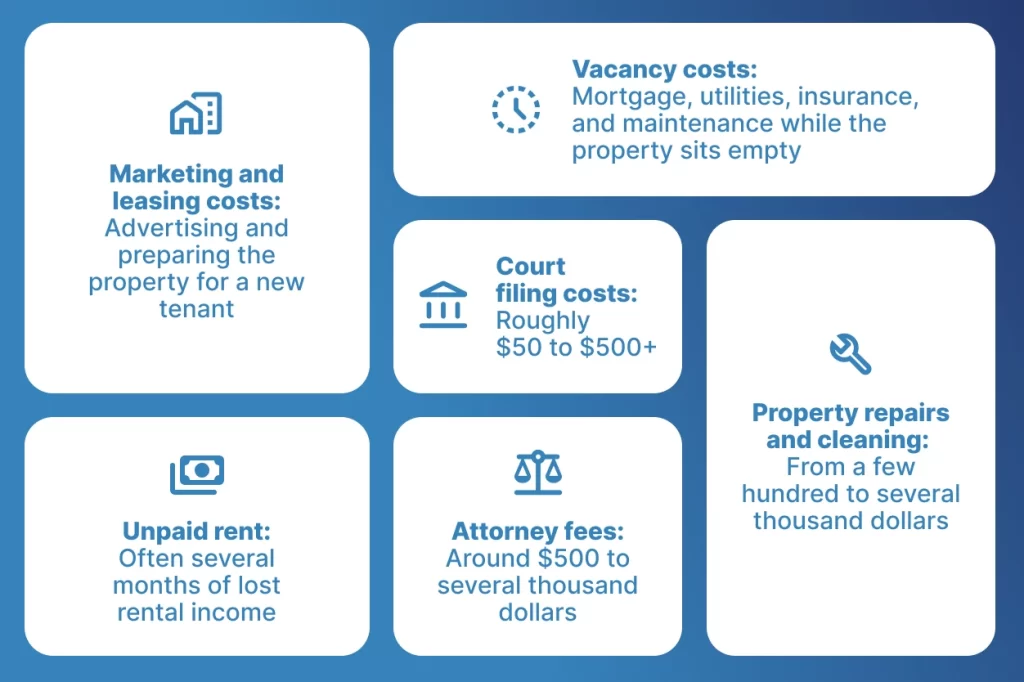
Common eviction-related expenses may include:
- Attorney fees: Around $500 to several thousand dollars
- Court filing costs: Roughly $50 to $500+
- Unpaid rent: Often several months of lost rental income
- Property repairs and cleaning: From a few hundred to several thousand dollars
- Vacancy costs: Mortgage, utilities, insurance, and maintenance while the property sits empty
- Marketing and leasing costs: Advertising and preparing the property for a new tenant
Evictions can be costly for tenants, too. Beyond the stress of losing housing, tenants may face moving expenses, damaged credit, difficulty renting another property in the future, unpaid balances, court judgments, or storage costs if belongings are removed.
In some cases, a cash-for-keys agreement may help both parties avoid a longer and more difficult process.
When Does Cash-for-Keys Make Sense?
Cash-for-keys agreements became especially common after banks began offering them to occupants living in foreclosed properties as a way to regain possession faster without going through lengthy eviction proceedings. Today, many landlords and real estate investors consider it primarily in situations where a faster and more cooperative transition may benefit both parties.
Some common situations include:
- Pre-foreclosure properties
- Distressed rental properties
- Tenant-occupied fix-and-flip projects
- Absentee or out-of-state landlords
- Inherited rental properties
- Long-term non-paying tenants
- Properties needing major renovations or remodeling
- Investors planning to sell the vacant property
Finding these types of distressed properties is only one part of the process.
In many cases, the bigger challenge is reaching terms that both the property owner and tenant are comfortable agreeing to. Clear communication, realistic expectations, and respectful negotiations are often what make a cash-for-keys agreement successful.
Related Read: How to Find Distressed Properties: Your Investment Opportunity Guide
How Investors Find Cash-for-Keys Opportunities
Finding potential cash-for-keys opportunities often starts with finding distressed or motivated property owners before the property reaches the broader market.
This is where real estate lead generation platforms like BatchLeads can help investors uncover off-market opportunities using foreclosure indicators, ownership data, equity filters, and distress-related signals.
Many investors specifically focus on off-market and distressed leads, such as:
- Absentee owners
- Pre-foreclosures
- Tax delinquent properties
- High-equity rentals
- Vacant homes
- Inherited properties
- Tired landlords
- Owners with HOA Fees

Over 47 million off-market absentee owner opportunities waiting to be uncovered.
Start your 7-day free trial with BatchLeads today.
Once a lead is identified, investors can use BatchLeads to skip-trace property owners, build focused lead lists, and connect with owners faster using built-in AI-powered outreach tools like Dialer AI.
Check out the quick walkthrough to learn more about BatchLeads:
Potential Issues With a Cash-for-Keys Agreement
Like any real estate negotiation, cash-for-keys agreements do not always go perfectly. While many situations are resolved smoothly, there are still legal, financial, and communication challenges landlords and investors should be aware of before moving forward.
Tenant Refuses To Move Out
One of the most common problems is when a tenant agrees initially but later refuses to leave the property. This can happen when the agreement is vague, poorly written, or missing important details like timelines, payment conditions, or move-out requirements.
To help avoid this, many landlords work with an attorney to properly document the agreement and clearly outline what both parties are agreeing to.
Illegal “Self-Help” Evictions
Some frustrated landlords make the mistake of trying to force tenants out by changing locks, shutting off utilities, ignoring repairs, or making the property difficult to live in. These are commonly referred to as “self-help” evictions and are illegal in many states.
Not only can this create lawsuits and fines, but it may also make the situation far worse for the property owner.
Negotiations Can Go Too Far
Cash-for-keys agreements are ultimately negotiations. Sometimes, landlords continue increasing the offer to the point where the agreement may no longer make financial sense compared to other options. Many investors try to calculate the total cost of delays, repairs, legal fees, and unpaid rent beforehand so they can negotiate from a realistic position.
Security Deposits Still Matter
A cash-for-keys agreement does not automatically eliminate the tenant’s security deposit. In most cases, landlords must still follow local laws regarding deposit handling, deductions, damages, and refund timelines just like a standard move-out process.
Local Laws Can Vary
Landlord-tenant laws differ significantly depending on the state and city. Some markets are considered more landlord-friendly, while others provide stronger tenant protections and stricter eviction rules. Because of this, many investors consult legal professionals before entering into a cash-for-keys agreement to ensure the process is handled properly.
If you are able to navigate these challenges and arrive at fair, realistic terms for both sides, a cash-for-keys agreement can sometimes become a faster and more practical solution than a lengthy eviction process.
Every distressed property has a story — Start your 7-day free trial of BatchLeads to read the fine print before anyone else.
FAQs
What is a cash-for-keys agreement?
A cash-for-keys agreement is a voluntary arrangement where a landlord or property owner offers a tenant money to move out of the property peacefully within an agreed timeframe.
Why do landlords use cash-for-keys agreements?
Many landlords use cash-for-keys agreements to avoid lengthy eviction processes, reduce legal expenses, minimize property damage risks, and regain possession of the property faster.
Is cash for keys cheaper than an eviction?
In some situations, yes. Evictions can involve attorney fees, court costs, unpaid rent, repairs, and vacancy expenses that may add up to thousands of dollars. Some landlords find that a cash-for-keys agreement can ultimately cost less overall.
What is the average cost of an eviction?
The cost of an eviction can vary depending on the state, court process, and how long the case takes. In many situations, landlords may spend anywhere from roughly $3,500 to $10,000 or more once attorney fees, court filing costs, unpaid rent, property repairs, cleaning, vacancy expenses, and lost rental income are added together.
Even simple evictions may involve $500 to several thousand dollars in legal fees alone, especially if the tenant contests the case.
What types of properties commonly involve cash-for-keys agreements?
Cash-for-keys agreements are often associated with distressed rental properties, pre-foreclosures, inherited homes, absentee-owner properties, and tenant-occupied fix-and-flip investments.
How do investors find cash-for-keys opportunities?
Many investors use platforms like BatchLeads to identify distressed and off-market properties using filters for pre-foreclosures, tax delinquency, absentee ownership, equity, and other distress indicators.
Are cash-for-keys agreements legal?
Cash-for-keys agreements are generally legal when handled properly and in compliance with local landlord-tenant laws. Investors and landlords should always consult legal professionals and follow state and local regulations before entering into an agreement.