


Disclaimer: The BatchLeads Fix-and-Flip Calculator provides estimates for informational purposes only. Its results do not guarantee profitability or constitute financial or investment advice. Actual costs and returns may vary. Verify your estimates and perform your own due diligence before making an investment decision.
| Quick Summary: To evaluate a potential fix-and-flip, estimate its after-repair value (ARV) using comparable sales, then subtract the full projected cost of buying, renovating, holding, financing, and selling the property. Divide estimated profit by total project costs to calculate project-cost ROI. The free BatchLeads Fix-and-Flip Calculator helps you compare scenarios, but its results depend on the estimates you enter. |
A house priced at $210,000 might seem like a promising flip if renovated homes nearby sell for $365,000. But the $155,000 difference is not your profit. Repairs, financing, property expenses, and selling costs all come out of it.
So how do you tell whether the deal is worth pursuing? Let’s break down the numbers, work through a sample flip, and see how changes in costs or resale price could affect your return before you make an offer.
Key Takeaways:
- The difference between the purchase price and the ARV is not profit. Include acquisition, renovation, financing, holding, and selling costs in your estimate.
- Use comparable renovated homes to estimate ARV, and leave room for repair overruns and a longer holding period.
- Calculate profit and ROI, then test how a lower sale price or higher costs would change the result.
- Use the free BatchLeads Fix-and-Flip Calculator to compare scenarios and verify your estimates before making an offer.
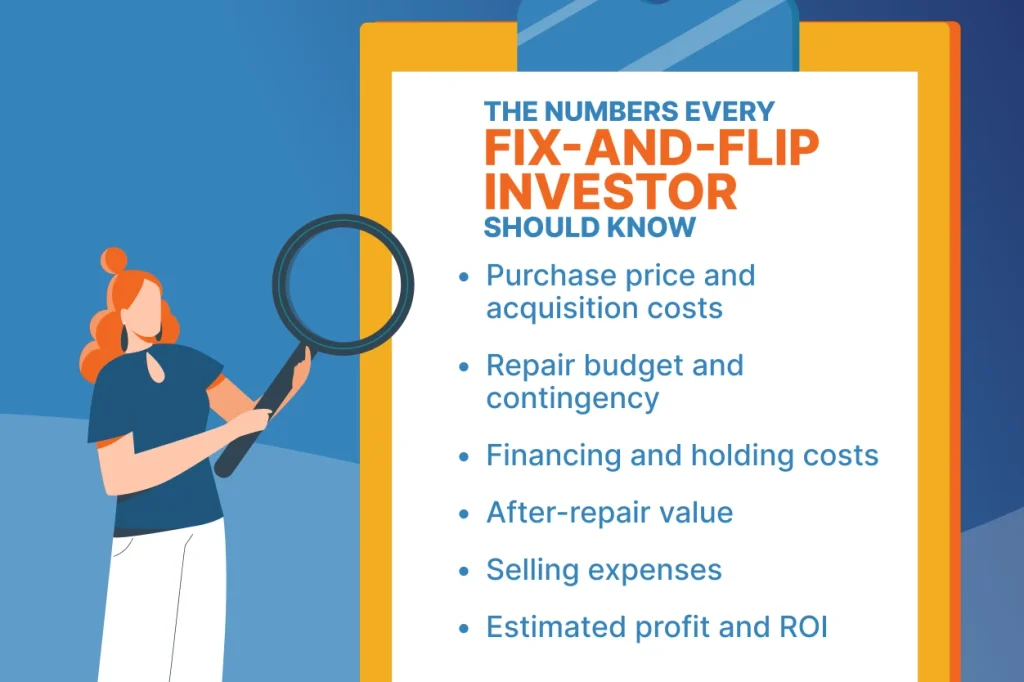
The Numbers Every Fix-and-Flip Investor Should Know
Purchase price and acquisition costs
Start with the price you expect to pay. Add the costs of acquiring the property, which may include inspections, title and escrow fees, transfer taxes, and other closing expenses.
Your offer is one of the few numbers you can negotiate directly. Set it with the full project budget in mind, rather than relying on the gap between the asking price and expected resale value.
Repair budget and contingency
Estimate the work needed to bring the home to a condition comparable to the renovated properties you expect buyers to consider. Break the budget into major categories, such as roofing, mechanical systems, kitchens, bathrooms, flooring, permits, and labor.
Financing and holding costs
If you borrow to fund the project, estimate lender fees, interest, and other financing charges over the expected timeline. Then account for the costs of owning the property until it sells, such as taxes, insurance, utilities, and maintenance.
A delayed renovation or slower sale can extend those expenses. Calculate what an extra month or two would cost, and keep financing and holding costs as separate line items so you do not double-count interest.
After-repair value
After-repair value (ARV) is your estimate of what the home could sell for after the planned renovation. It is neither its current value nor a guaranteed sale price.
Review recent sales of renovated homes with similar locations, sizes, layouts, conditions, and features. If your planned finish level falls short of the homes you are comparing it with, adjust your expectation accordingly. BatchLeads’ guide to ARV offers more detail on using comparable sales.
Pro Tip: Be cautious when one exceptional sale is doing most of the work in your estimate. Consider what the property could bring if you need to accept a lower offer.
Selling expenses
The resale price is not the amount you take home. Estimate the likely costs of selling, including agent compensation, seller closing costs, concessions, staging, and any other expenses relevant to your transaction. Use the terms you expect for the deal, rather than assuming a single percentage applies everywhere.
Estimated profit and ROI
Once you have an expected resale price and a complete cost estimate, calculate:
Estimated profit = Expected resale price – Total projected project costs
For an all-cash comparison, you can calculate a simple project-cost ROI as:
Project cost ROI = Estimated profit ÷ Total projected project costs × 100
The denominator matters. ROI based on total project costs differs from a cash-on-cash return when a deal uses financing. If you use debt, define the cash you actually invest and account for borrowing costs and repayment separately.
Note: Do not subtract the loan principal as an additional expense if the purchase and renovation funds are already included in your project costs.
A Fix-and-Flip Example: From ARV to Potential Profit
Suppose you are evaluating a home with a projected ARV of $365,000. Your preliminary estimates look like this:
| Item | Estimate |
| Purchase price | $210,000 |
| Acquisition costs | $5,000 |
| Repairs | $55,000 |
| Repair contingency | $7,000 |
| Financing charges | $12,000 |
| Holding costs, excluding financing | $9,000 |
| Selling expenses | $24,000 |
| Total projected project costs | $322,000 |
| Projected ARV | $365,000 |
| Estimated profit | $43,000 |
| Project-cost ROI | 13.4% |
In this scenario, $365,000 minus $322,000 leaves $43,000 in estimated profit. Dividing that by $322,000 yields a project cost ROI of about 13.4%.
Note: These are hypothetical figures and not a forecast for any specific property.
| Now test a less favorable outcome! If the sale price comes in at $345,000 and repairs cost $10,000 more than planned, the projected cost rises to $332,000. Estimated profit falls to $13,000, and project-cost ROI drops to about 3.9%. Any additional delay or concession would narrow that margin further. |
A strong deal analysis looks beyond one optimistic projection. Before making an offer, you can use the Fix-and-Flip Calculator to run through different scenarios to see whether the deal still meets your goals.
Use the BatchLeads Fix-and-Flip Calculator to Compare Scenarios for Free
You do not need to rebuild a spreadsheet for every first-pass review. The BatchLeads Fix-and-Flip Calculator organizes the inputs into five tabs:
| Tab | What you enter |
| Purchase | Purchase price, closing costs, and inspection fees |
| Financing | Hard money, conventional, or cash; down payment percentage, interest rate, loan origination fees, and loan term in months |
| Holding Costs | Monthly property taxes, insurance, utilities, and HOA fees |
| Renovation | Renovation budget, contingency percentage, and timeline in months |
| Sale | After-repair value and selling costs as a percentage |
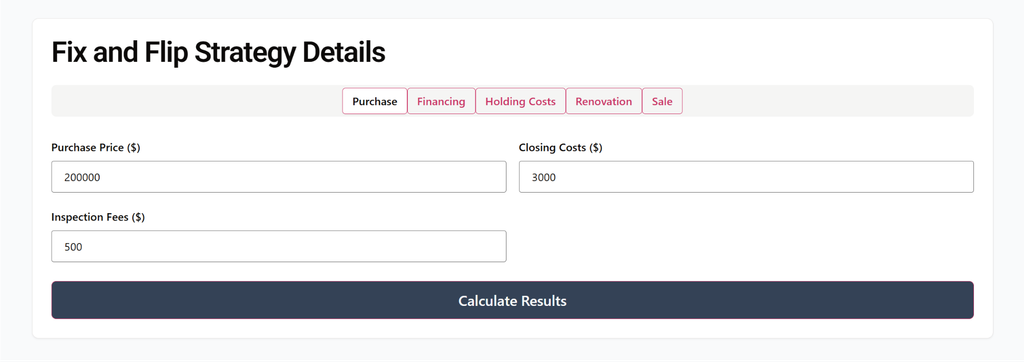
After entering the inputs, select Calculate Results to review the investment summary, including total investment, gross profit, net profit, ROI, and annualized ROI.
Here is a sample scenario using the BatchLeads Fix and Flip Calculator
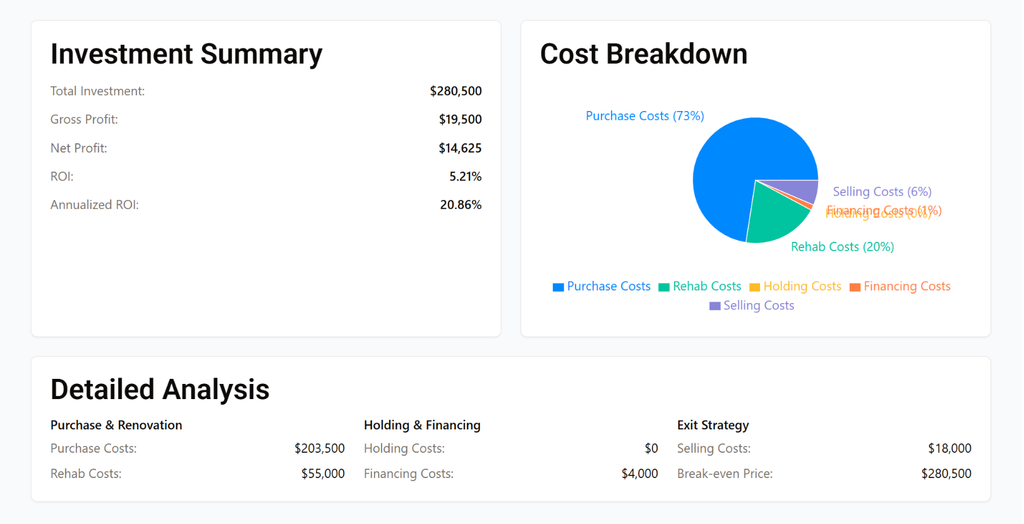
The cost breakdown shows how much of the project budget goes toward purchase, renovation, holding, financing, and selling. You can also check the detailed analysis for those cost totals and the estimated break-even price.
Review the exit strategy and how the calculator arrives at each figure before using the results to guide an offer.
Pro Tip: The 70% rule can help frame an initial offer, but treat it as a screening benchmark. Always verify ARV with a local real estate agent or appraiser to avoid overestimating.
Validate Every Estimate Before You Commit
A calculator organizes your assumptions; it cannot verify them for you.
- Check the property and title. Verify ownership, liens, access, permits, and conditions through appropriate records and inspections.
- Confirm the renovation budget. Get a detailed scope and contractor bids, particularly for major systems or structural work. Reassess your contingency if the scope changes.
- Review the comps. Make sure the recently sold homes you use to estimate ARV are comparable to the finished property you plan to deliver.
- Verify financing and closing costs. Replace preliminary figures with lender and settlement estimates specific to the deal.
- Test a less favorable outcome. Lower the expected sale price, increase repair costs, and extend the timeline to see whether the project still meets your minimum return.
A potential flip can look attractive at first glance and still fail to meet your investment criteria once the full budget is included. Running the numbers early helps you focus your due diligence and make offers with a clearer view of the margin.
Common Fix-and-Flip Deal Analysis Mistakes
Watch out for these as you build your first estimate.
- Looking only at the purchase price and ARV. The gap between them is not profit. Acquisition, financing, holding, renovation, and selling costs all reduce it.
- Using the best comp as the expected sale price. A larger home or one with better finishes may sell for more than your completed project.
- Leaving no room for repair overruns. A preliminary estimate can miss costly work, especially when the property’s condition is not fully known.
- Underestimating the time to sell. The property may continue to generate interest and holding costs after renovation ends.
- Comparing ROI figures with different denominators. A return based on total project costs is different from one based on the cash you invested.
- Relying on the 70% rule alone. It can help screen a deal, but your offer should reflect the property’s actual costs, timeline, and required return.
Find the Next Flip Worth Running the Numbers On
The free calculator helps you decide whether a potential flip is worth pursuing. Finding that property in the first place takes a wider set of tools.
With BatchLeads, you can identify properties through customizable searches or Driving for Dollars, review property details and comparable sales, and keep promising leads organized. When the numbers look right, use BatchLeads’ skip tracing to find available owner contact information, and then use outreach tools to take the next step.
Want to see how it works?
Ready to find your next potential flip? Explore BatchLeads and start your 7-day free trial.
FAQs
How do I estimate profit on a fix-and-flip?
Subtract all projected project costs from the expected resale price. Include the purchase, acquisition, renovation, financing, holding, and selling costs. The difference between purchase price and ARV alone is not profit.
How do I estimate after-repair value?
Look at recent sales of renovated homes similar to your planned finished property. Compare location, size, layout, condition, and features. If your renovation will not match a comp’s finish level, do not assume your property will sell for the same price.
BatchLeads’ comping tools can help you examine nearby sales as you develop an estimate. Start a 7-day free trial to learn more.
What is a good ROI for a fix-and-flip?
There is no single ROI that makes every flip worthwhile. Your required return should account for the cash involved, the time the project may take, and the risk that costs or the sale price will differ from your estimates.
How do I decide the most I can offer for a property?
Start with a realistic resale estimate. Subtract projected repairs, acquisition, financing, holding, and selling costs, along with the profit you need from the deal. What remains is a preliminary offer ceiling, which you should revisit as you verify the estimates.
Does a high ARV mean a flip will be profitable?
No. ARV estimates the potential resale price after renovation. Profit depends on what you pay for the property and everything you spend to renovate, hold, finance, and sell it.
How much time should I include when estimating holding costs?
Plan beyond the renovation timeline. You may continue paying interest, taxes, insurance, and utilities while the home is listed and during the buyer’s closing period. Test the cost of an additional month or two if the schedule is uncertain.
Should I count the loan principal as a separate project expense?
Do not add the loan principal to the purchase or renovation costs it funded; that would double-count those costs. Include borrowing costs such as interest and origination fees, and account for loan repayment when assessing how much cash you receive at the sale.
Should I ask a local expert to review my ARV estimate?
Yes. After reviewing comparable sales, ask a local real estate agent or appraiser to assess your projected value. Share the property’s current condition and planned renovation so they can judge whether your comps reflect the home you expect to sell. Their input can strengthen your estimate, though it cannot guarantee the final sale price.
What’s an easy way to compare different fix-and-flip scenarios?
Use a Fix-and-Flip Calculator to change assumptions such as purchase price, renovation budget, holding costs, and ARV. Review how each change affects the estimated profit and ROI before deciding what to offer.