

Get a summary of this article with your favorite AI:
Disclaimer: This article is for informational purposes only. BatchLeads does not provide legal, financial, or investment advice. Always verify property information, conduct your own research, and comply with applicable laws before pursuing real estate opportunities.
|
Which is better, Driving for Dollars or list stacking? |
Some investors prefer driving through neighborhoods to identify properties that appear vacant or neglected. Others rely on property data to find owners whose circumstances may indicate a potential selling opportunity.
These approaches are known as Driving for Dollars and list stacking, respectively.
Both are popular real estate lead generation strategies, each offering distinct advantages. Let's explore their key differences, strengths, and limitations, and how investors can combine both approaches to find potential real estate deals.
Key Takeaways
- Driving for Dollars helps investors discover overlooked properties through firsthand observations, while list stacking uses property and ownership data to identify potential opportunities.
- Wholesalers, fix-and-flip investors, and acquisition teams can benefit from either strategy depending on their markets, available resources, and prospecting needs.
- Combining both can improve lead prioritization. Using physical observations alongside property data can help investors validate potential leads, focus their outreach, and make more informed prospecting decisions.
Driving for Dollars vs. List Stacking: Key Differences
While both strategies help investors identify potential off-market real estate leads, they differ in how properties are discovered, researched, and prioritized.
|
Factor |
Driving for Dollars |
List Stacking |
|
Approach |
Identifying properties through physical observation |
Combining property and ownership data |
|
Key indicators |
Overgrown lawns, boarded windows, visible damage, possible vacancy |
Vacancy, absentee ownership, tax delinquency, high equity |
|
Best suited for |
Local prospecting and neighborhood research |
Researching and prioritizing larger lead lists |
|
Time investment |
Requires driving and fieldwork |
Requires property research and list management |
|
Geographic reach |
Primarily local markets |
Local or multiple markets |
|
Main advantage |
Can uncover properties overlooked by traditional searches |
Identifies overlapping property characteristics |
|
Main limitation |
Physical conditions don't confirm seller motivation |
Property data may be outdated or incomplete unless sourced from a reliable real estate data platform |
Ultimately, the biggest difference comes down to how investors identify off-market opportunities: Driving for Dollars relies on what they can observe firsthand, while list stacking uses property data to uncover potential leads that may not be immediately visible.
Which Strategy Offers the Most Value to Real Estate Investors?

The best approach depends on the opportunities you're looking for, the markets you operate in, and how you manage your prospecting efforts.
Here's how different real estate investors can benefit from each strategy.
Wholesalers: Discover Opportunities Beyond Traditional Lead Lists
If you're a wholesaler competing for off-market deals, relying on the same lead lists as everyone else can make it harder to uncover overlooked opportunities.
Driving for Dollars gives you another way to explore neighborhoods and spot properties that may not stand out in a conventional property search.
For example: Imagine driving through a neighborhood and noticing a home with a damaged roof and an overgrown yard. The property may not appear on your existing distressed property lists, but its visible condition gives you a reason to investigate.
You can research the address, identify the owner, and assess whether the property fits your acquisition criteria.
Fix-and-Flip Investors: Find Properties With Renovation Potential
For fix-and-flip investors, finding a property that needs repairs is only part of the equation. The potential purchase price, renovation costs, and resale value also matter.
Driving for Dollars can help you spot properties with visible signs of deferred maintenance, while list stacking can help you identify properties with ownership characteristics worth investigating, such as high equity, absentee ownership, or long-term ownership.
For example: Suppose you're researching a neighborhood where renovated homes typically sell for around $300,000.
You could use Driving for Dollars to identify homes that appear to need repairs, then compare those properties against absentee-owner and high-equity lists. Alternatively, you could start with stacked lists and visit shortlisted properties to assess their visible condition.
Either way, the goal is to identify properties worth evaluating further based on their condition, ownership details, and potential investment returns.
Pro Tip: Neither strategy replaces a proper deal analysis, but together they can help you focus on opportunities that better align with your renovation budget and investment goals.
For Acquisition Teams: Prioritize Leads Without Losing Local Context
When your team is managing hundreds or thousands of potential leads, deciding which properties to research first can be challenging.
List stacking can help identify properties matching multiple relevant criteria, while Driving for Dollars adds firsthand observations that property records may not capture.
|
Consider this scenario: You have a list of 500 absentee-owned properties. After comparing it with vacancy and tax-delinquency lists, 60 properties match additional criteria. Rather than treating all 500 properties equally, you or your team can prioritize those 60 for further research. For properties in your local market, a neighborhood drive may provide additional context about their physical condition. |
This combination can help your team organize its prospecting efforts and make more informed decisions about where to focus its resources.
How to Combine Driving for Dollars and List Stacking With BatchLeads
With BatchLeads, you can save properties while driving, research ownership information, and use list stacking to identify leads that match multiple criteria.
Here's how to put both strategies to work.
Step 1: Discover and Organize Potential Properties
Start by exploring neighborhoods that align with your investment goals. Look for properties showing signs of vacancy, deferred maintenance, or visible distress.
With the BatchLeads mobile app, you can track your driving routes, save properties as you discover them, and organize them into a dedicated lead list.
For example, you might identify 30 potentially distressed properties during a neighborhood drive and save them for further research.
Pro Tip: You can also use BatchLeads' Virtual Driving for Dollars, which uses Google Street View, to explore neighborhoods remotely and discover properties beyond your local market. Keep in mind that Street View images may be outdated, so verify property conditions before pursuing a lead
Step 2: Research Properties and Build Relevant Lists
Next, look beyond the property's exterior condition.
Use BatchLeads to research available ownership information, estimated equity, property characteristics, and other relevant details.
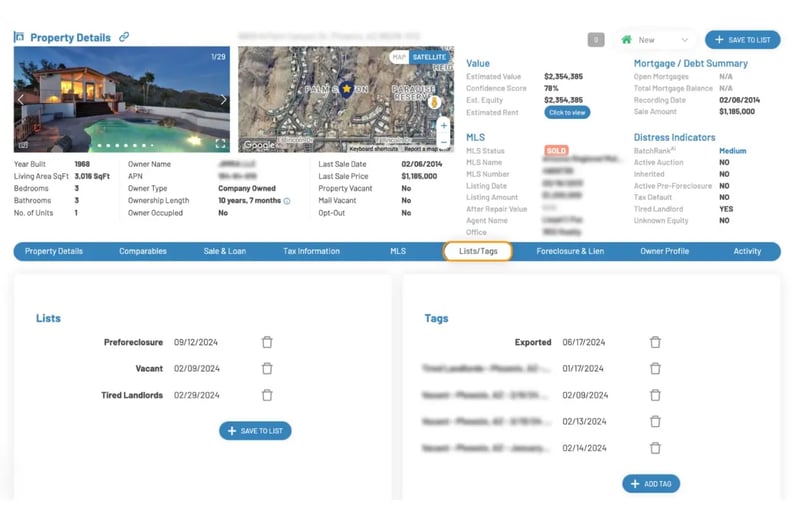
You can also use property filters to build separate lists of absentee-owned, vacant, or high-equity properties, giving you additional information to compare against your Driving for Dollars discoveries.
Step 3: Stack Lists to Identify Promising Leads
Now, compare your saved properties against other relevant lead lists.
With BatchLeads' list stacking capabilities, you can use List Count and Tag Count filters to identify properties appearing across multiple lists or matching your saved tags.
For example, of the 30 properties you discovered while driving, five might also appear on your absentee-owner or high-equity lists.
These overlapping indicators can help you decide which properties deserve closer investigation.
Step 4: Prioritize Leads and Plan Your Outreach
Once you've narrowed your list, review the most promising properties and organize your next steps.
BatchLeads lets you add property notes, research owner information, run comparable sales analyses, and use free skip tracing to find potential contact details.
From there, you can use BatchLeads' built-in Click-to-Dial and direct mail tools to reach property owners or seamlessly integrate and push lead lists to BatchDialer for high-volume calling campaigns, all while keeping your prospecting efforts organized.
By combining both strategies with BatchLeads, you can turn neighborhood discoveries into more informed investment opportunities, spend less time sorting through leads, and focus your outreach on properties that best align with your investment goals.
Ready to put both strategies into action? Start your 7-day free trial of BatchLeads and discover, organize, and prioritize your next potential deal.
Common Mistakes Investors Make When Combining Driving for Dollars and List Stacking
Combining both strategies can help you identify promising properties, but it's important not to confuse potential opportunities with guaranteed deals. Here are a few mistakes to watch out for:
- Assuming visible distress means seller motivation: An overgrown lawn, boarded-up window, or damaged exterior doesn't necessarily mean the owner wants to sell. Treat these observations as reasons to investigate, not proof of motivation.
- Stacking lists just to increase the number of matches: More overlapping indicators don't automatically mean better leads. Focus on combinations that align with your investment criteria and provide meaningful information about a property.
- Relying on outdated or unreliable property data: Ownership details, equity estimates, and occupancy status can change over time. Using a trusted real estate data platform like BatchLeads can help you access comprehensive property information, identify relevant leads, and make more informed prospecting decisions.
- Overlooking the actual deal numbers: A property might look promising both in person and on paper, but acquisition costs, repair expenses, and local market conditions ultimately determine whether the investment makes financial sense.
- Neglecting lead follow-ups: Even promising opportunities can go nowhere without consistent outreach. Keep your leads organized, track conversations, and follow up appropriately while respecting applicable outreach regulations.
Pro Tip: Track which leads generate meaningful seller conversations, appointments, and potential deals. Over time, this can help you identify which property characteristics and lead sources are most valuable for your investment strategy.
Find Better Real Estate Opportunities With BatchLeads
Driving for Dollars helps uncover overlooked properties, while list stacking helps prioritize leads worth pursuing. Together, they can make your prospecting more focused and efficient.
With BatchLeads, you can combine property discovery, list stacking, and outreach in one platform to identify promising opportunities and connect with potential sellers.
Try BatchLeads free for 7 days and start prospecting smarter.
FAQs
Is Driving for Dollars better than list stacking?
Neither strategy is inherently better. Driving for Dollars is useful for discovering overlooked properties through physical observation, while list stacking helps investors prioritize leads based on overlapping property and ownership indicators. The best approach depends on your investment goals and available resources.
Can beginners use Driving for Dollars and list stacking?
Yes. Beginners can start with Driving for Dollars to identify properties in familiar neighborhoods and use list stacking to research ownership characteristics. Combining both can help them develop a more structured approach to finding potential investment opportunities.
What are the best lists to stack for motivated seller leads?
Common lists include absentee-owned, vacant, tax-delinquent, high-equity, and long-term-owned properties. The most useful combinations depend on your investment strategy, and appearing on multiple lists doesn't necessarily indicate that an owner is motivated to sell.
How can I find off-market real estate deals using both strategies?
Start by identifying potential properties through Driving for Dollars or property searches. Then, compare those properties against relevant ownership and distress-related lists, verify the available information, and prioritize leads that align with your acquisition criteria.
Does Driving for Dollars work in competitive real estate markets?
Driving for Dollars can be useful in competitive markets because it allows investors to identify properties through firsthand observations rather than relying exclusively on commonly available lead lists. However, finding an overlooked property doesn't guarantee less competition or a successful deal.
Can BatchLeads help with both Driving for Dollars and list stacking?
Yes. BatchLeads offers a mobile Driving for Dollars workflow with route tracking and property saving, alongside property filters, list stacking, and lead management tools. Investors can also use built-in Click-to-Dial, direct mail, and BatchDialer integration to support their outreach efforts.
Try BatchLeads free for 7 days to put these strategies into action.